🌿 Winter 2026/27 — Costa Rica & Dominican Republic cohorts depart December 26.  Learn More →
Free Guide

The Ethical
Service-Learning Guide

A practical introduction to volunteering responsibly — how to serve in a way that genuinely helps the people and places you set out to support.

Why This Guide Exists

Good Intentions Are Not Enough

Service done without preparation can unintentionally cause harm — to communities, to local economies, and to the trust that makes service possible. This guide distills field-tested principles and questions you can use before, during, and after any service experience, whether abroad or close to home.

Sustained behavior change through global service since 2006. Help2Serve.Care is a U.S.-based 501(c)(3) nonprofit dedicated to meaningful, ethical global service-learning.

Request an Info / Q&A Session

Have questions, or want guidance as you begin? Request a live Info / Q&A session with Help2Serve.Care and our team will walk you through the details and support you at every step.

Pathway 8 — Virtual Info Sessions & Events →
Download this guide as a PDF →
Part One

What “Ethical Service” Actually Means

Service-learning combines meaningful community service with structured reflection and learning. It is ethical when the people being served are genuinely better off, when local voices lead, and when the volunteer grows without that growth coming at the community’s expense.

The difference between service that helps and service that harms rarely comes down to intent — almost everyone means well. It comes down to preparation, humility, and a willingness to follow rather than lead.

Community-led
The community identifies its own needs and priorities. Volunteers contribute to a plan the community already owns — they do not arrive with one.
Do no harm
Before contributing, ask whether your involvement could displace local workers, interrupt children’s attachments, or create dependency. If it might, change the approach.
Humility over heroism
You are a guest and a learner first. The most valuable volunteers listen more than they speak.
Sustainability
Good service strengthens something that continues after you leave — a skill, a structure, a relationship — rather than something that depends on a constant stream of visitors.
Part Two

Before You Serve

Most of the work of ethical service happens before you arrive. Preparation is the difference between being an asset and being a burden.

Prepare Yourself

Learn the history, culture, and current context of the place you will serve — beyond the guidebook.
Understand the specific problem you are contributing to, and who is already working on it locally.
Be honest about your actual skills. Enthusiasm is not a qualification; match what you offer to what is genuinely needed.
Learn basic phrases in the local language, and the customs around dress, greetings, and respect.
Set expectations: you will likely change more than the community does in a short program — and that is okay.

Questions to Ask Any Service Program

01
How were these projects chosen, and what role did the community play in choosing them?
02
Does my participation ever replace work a local person could be paid to do?
03
What happens to this project between volunteer groups?
04
How do you protect children, and what is your child-safeguarding policy?
05
How do you measure whether the community — not just the volunteer — benefits?
A note on working with children

Short-term volunteers should never be placed in primary caregiving roles for children, and ethical organizations do not run programs based in residential orphanages. Repeated short-term attachments can harm children’s development. Responsible programs support children through schools, families, and trained local staff — with volunteers in supplementary, supervised roles.

Part Three

While You Serve

🤝
Follow local leadership.
Local staff and community members know the context. Take direction; do not override it.
🔨
Let the work be theirs.
If a task can be done by a community member, it should be. Your role is to support capacity, not to substitute for it.
📷
Photograph with consent and dignity.
Always ask before photographing, never photograph children without a guardian’s permission, and avoid images that portray people as helpless.
💭
Reflect honestly.
Structured reflection is where service becomes learning. Sit with discomfort instead of explaining it away.
🏪
Spend locally.
Support local businesses, guides, and markets so the economic benefit of your visit stays in the community.

The “Single Story” Trap

It is easy to return from a service experience with one simplified narrative — of need, of gratitude, of your own transformation. Real communities are complex, capable, and far more than the challenges a short visit reveals. Resist flattening them into a single story, especially when you tell others about your experience.

“The most meaningful service does not rescue anyone. It joins people who are already doing the work — and stays humble about how much there is still to learn.”

Part Four

After You Serve — Sustaining the Change

The end of a program is not the end of service. The volunteers who create the most lasting impact treat their experience as a beginning — the start of a lifelong commitment expressed in everyday choices, not occasional trips.

Tell honest, dignified stories that center the community — not dramatized or self-congratulatory ones.
Stay engaged with the issue you served: locally, through study, through advocacy, or through ongoing support.
Bring service home — your own community has real needs and benefits from the same commitment.
Mentor the next volunteer. Sharing what you learned multiplies impact across generations of service.
Give where it lasts: support local organizations led by the communities themselves.

Carry it forward with Help2Serve.Care

Ethical service is a practice, not a single decision. Explore nine ways to stay engaged — from global immersion programs and campus clubs to the alumni network, virtual info sessions, and local service pathways.

Explore Nine Ways to Stay Engaged →

© 2026 Help2Serve.Care · U.S.-Based 501(c)(3) Nonprofit (EIN: 93-3620516) · El Dorado Hills, CA · info@help2serve.care. This guide may be freely shared for educational, non-commercial purposes with attribution.

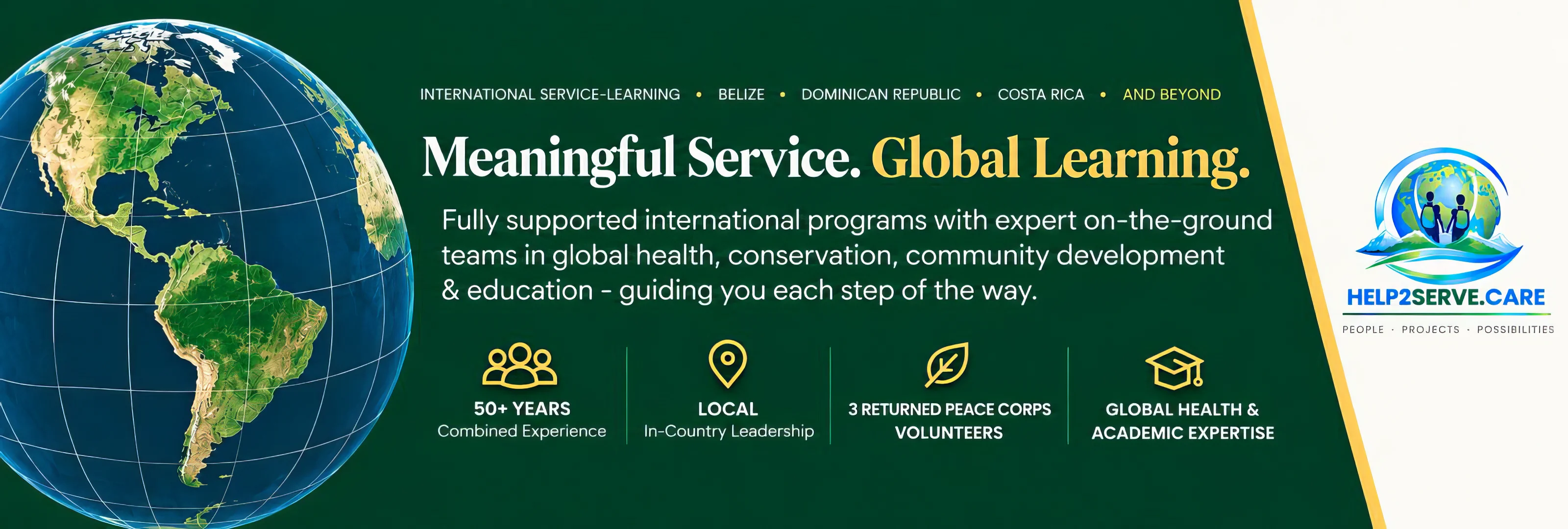
Help2Serve.Care — Meaningful Service. Global Learning. Fully supported international programs with expert on-the-ground teams in global health, conservation, community development and education, guiding you each step of the way. International service-learning in Belize, Dominican Republic, Costa Rica and beyond. 50+ years combined experience, local in-country leadership, 3 Returned Peace Corps Volunteers, global health and academic expertise.
Cookie preferences