🌿 Winter 2026/27 — Costa Rica & Dominican Republic cohorts depart December 26.  Learn More →
Free Guide

The College
Credit Guide

How to earn academic credit for your Help2Serve.Care global service-learning experience — step by step.

Why Earn Academic Credit?

More Than Travel

A Help2Serve.Care immersion experience is more than travel — it is structured, experiential learning grounded in service, leadership development, cultural engagement, and real-world problem solving. Many students translate that experience into academic credit through independent study, service-learning, internship, practicum, experiential education, or departmental coursework pathways at their college or university.

Sustained behavior change through global service since 2006. Help2Serve.Care is a U.S.-based 501(c)(3) nonprofit dedicated to meaningful, ethical global service-learning.

Request an Info / Q&A Session

Have questions about earning credit? Request a live Info / Q&A session with Help2Serve.Care and we will help you prepare for the conversation with your institution.

Pathway 8 — Virtual Info Sessions & Events →
Download this guide as a PDF →
Why It Matters

Turning Service Into Credit

Earning credit can help you:

Strengthen graduate school and professional applications.
Connect classroom learning to real-world experience.
Deepen reflection and academic integration.
Demonstrate initiative, leadership, and cross-cultural engagement.
Maximize the educational value of your immersion experience.

This guide walks you through the process step by step so you can begin the conversation with your institution early and confidently.

Part One

How Academic Credit Works

Academic credit is ultimately granted by your own institution — not directly by Help2Serve.Care. However, Help2Serve.Care supports students throughout the process by providing documentation, evaluations, program materials, and verification commonly requested by faculty sponsors, registrars, and academic departments.

Students most commonly earn credit through:

Independent study courses.
Service-learning programs.
Internships or practica.
Experiential learning pathways.
Honors projects.
Departmental elective credit.

Because every college and university has different requirements, starting early and communicating proactively with your academic advisor is one of the most important steps. Many schools are increasingly supportive of structured experiential learning that combines service, reflection, leadership development, and global engagement.

Part Two

Your Step-by-Step Path

01
Start early.
Begin at least one academic term before departure. Credit approval often requires faculty review, department signatures, and registration deadlines.
02
Meet with your academic advisor.
Ask how experiential learning, independent study, internship, or service-learning credit works within your department and degree pathway.
03
Identify a faculty sponsor.
Many schools require a faculty member to supervise your academic objectives, guide reflection, and evaluate final deliverables.
04
Define meaningful learning objectives.
Work with your sponsor to create learning goals tied to your major, professional interests, leadership development, or broader academic outcomes.
05
Request documentation from Help2Serve.Care.
We provide materials commonly requested by universities (see below).
06
Complete your institution’s application process.
Submit required paperwork before registration deadlines — independent-study forms, internship applications, learning contracts, or departmental approvals.
07
Complete reflection and assessment requirements.
Most pathways include structured reflection through journals, presentations, research papers, portfolios, or faculty evaluations.

Example learning objective areas

Public health systems.
Sustainability and conservation.
Education and childhood development.
Intercultural communication.
Leadership and social impact.
Ethical service-learning practices.

What Help2Serve.Care Provides

Official program descriptions.
Structured service-learning syllabi.
Verification of service hours.
Program leader evaluations.
Educational outcome documentation.
Support letters when requested.
Guidance for academic integration conversations.
How to request documentation

Documentation can be requested through your program coordinator. Start the conversation early — the most common reason students miss out on credit is simply starting too late.

Part Three

Questions to Ask Your Advisor

Bring these questions to your advisor and faculty sponsor:

01
Does my department offer independent study, internship, experiential learning, or service-learning credit?
02
What registration deadlines or approvals do I need to meet?
03
Which faculty members have supervised experiential credit before?
04
What reflection or assessment requirements will be expected?
05
Can this credit apply toward my major, minor, honors program, or electives?
06
Are there opportunities to connect this experience to research, capstone, or graduate preparation goals?
A note on credit hours

Each institution and accreditor sets its own credit-hour standards. A common benchmark is roughly 45 hours of student work per credit hour, but this varies. Your advisor and faculty sponsor determine the actual number of credits your institution will award.

Take the Next Step

Global service-learning can become one of the most meaningful parts of your educational journey.

Learn more about academic credit, or connect with a program mentor to discuss your academic and career goals.

Academic Credit Details →

Connect with a program mentor — Pathway 5 →

© 2026 Help2Serve.Care · U.S.-Based 501(c)(3) Nonprofit (EIN: 93-3620516) · El Dorado Hills, CA · info@help2serve.care. This guide may be freely shared for educational, non-commercial purposes with attribution.

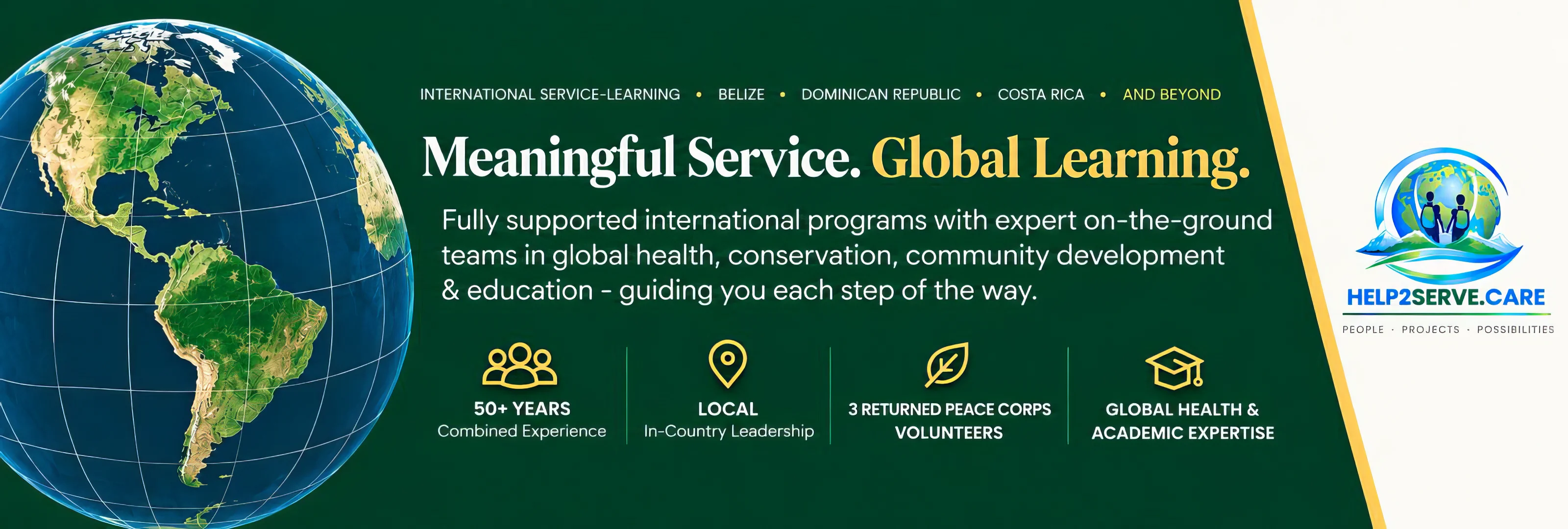
Help2Serve.Care — Meaningful Service. Global Learning. Fully supported international programs with expert on-the-ground teams in global health, conservation, community development and education, guiding you each step of the way. International service-learning in Belize, Dominican Republic, Costa Rica and beyond. 50+ years combined experience, local in-country leadership, 3 Returned Peace Corps Volunteers, global health and academic expertise.
Cookie preferences